Synqly solves the operational complexity of building and maintaining integrations across many services while keeping a consistent, unified developer experience.
Instead of writing custom code for every provider, your application integrates once with Synqly's unified APIs. Synqly handles translation, normalization, and provider-specific execution behind the scenes.
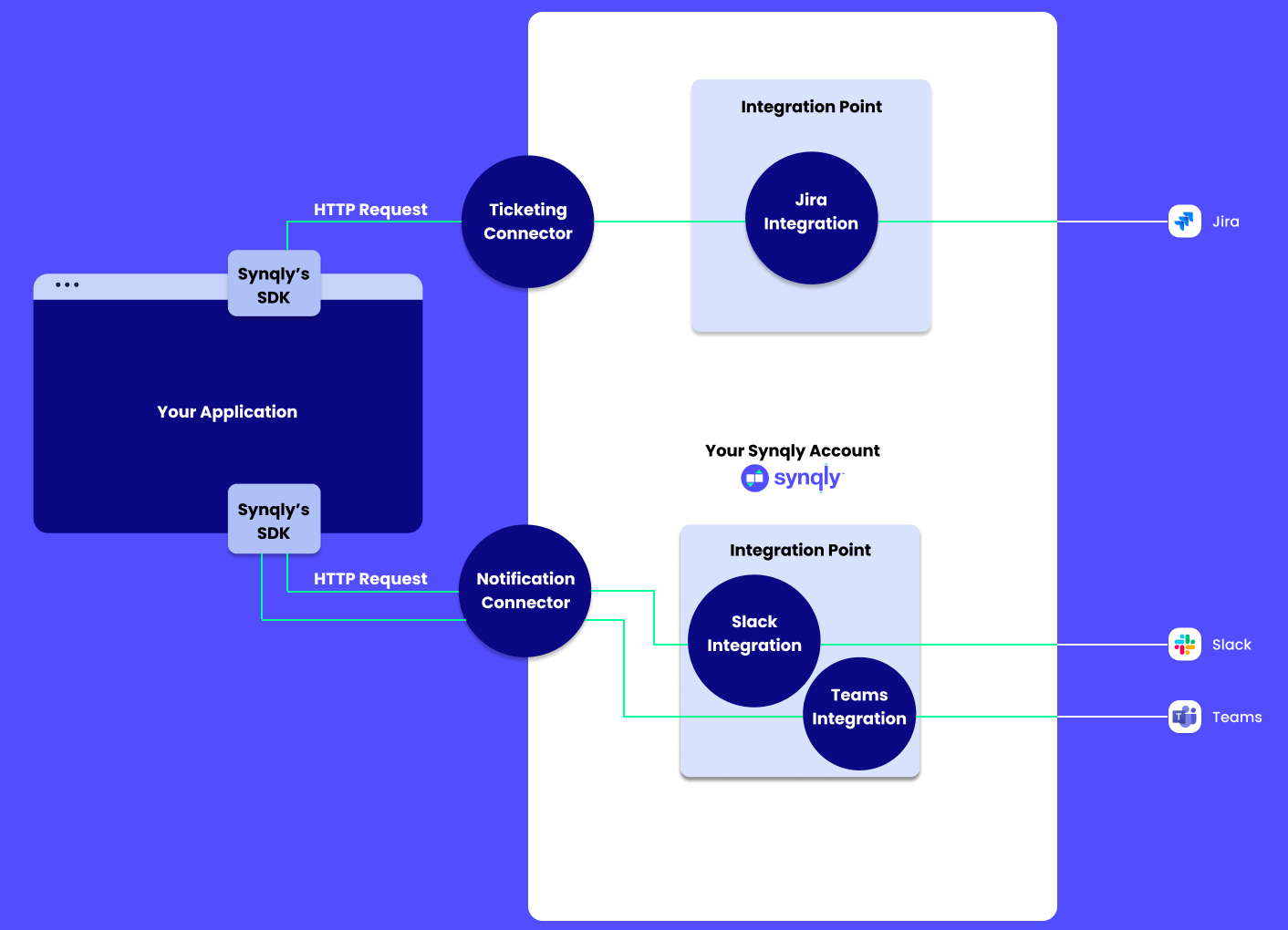
Internally, Synqly introduces organizational, integration, and security models that ensure tenant isolation, secure authentication, and scalable integration management. Those models are the real foundation of the platform and understanding them makes everything else click.
The Synqly platform is built around three connected layers. Each exists to solve a distinct architectural problem.
Organizational Model
Who owns what. Defines ownership, access control, and how customer data stays isolated across your entire deployment.
Integration Model
How things connect. Defines how external systems are wired up, configured, and made reusable across tenants.
Authentication Model
How access is controlled. Separates administrative authority from runtime execution using distinct token scopes.
Who owns what. Defines ownership, access control, and how customer data stays isolated across your entire deployment.
At the root of this model is the Organization, which owns the resources required to operate an integration ecosystem, including Members, Integration Points, and Accounts. Accounts typically represent your customers or tenants, providing isolated environments where integrations can be configured and managed independently.
Understanding the Organizational Model is essential for understanding how Synqly approaches multi-tenancy, security, and resource ownership.
The following sections explore each concept in greater detail and explain how they work together to establish ownership boundaries.
Organization
The root container that owns all Synqly resources and establishes the governance boundary.
Members
Personal accounts and service accounts that act within an Organization.
Accounts
Synqly's representation of your customers, providing strict data isolation between tenants.
End Users
The customers of your customers who authenticate providers or configure connections.
How things connect. Defines how external systems are wired up, configured, and made reusable across your tenants.
At a high level, the model separates:
- What your application integrates with (Connector)
- How that integration is governed (Integration Point)
- Which provider is actually connected (Integration)
This separation allows applications to integrate against a stable, unified interface while retaining the flexibility to connect different providers for different customers or environments.
The following sections explain each component of the Integration Model in detail. Start with the concept you're interested in, or read them in order to understand how integrations are built from the unified interface down to the provider connection
Connectors
A unified API and data model abstracting a category of providers, such as Ticketing or Identity.
Integration Points
Reusable governance rules defined once at the Organization level and applied across many Integrations.
Integrations
The live, authorized connection between an Account and a specific Provider.
Providers
Specific third-party platforms — Jira, Okta, Slack, AWS — that Connectors expose.
How access is controlled. Separates administrative authority from runtime execution using distinct token scopes.
Synqly exposes two distinct API layers, and each requires a different kind of credential.
The Management APIs control how your integration system is structured — creating Accounts, configuring Integration Points, managing Members. The Connector APIs perform the actual work against external providers — fetching tickets, querying identity events, routing alerts.
These two layers carry fundamentally different levels of authority, and Synqly enforces that separation by design.
| Token | API layer | Authority |
|---|---|---|
| Organization Access Token | Management APIs | Broad — operates across the entire Organization |
| Integration Access Token | Connector APIs | Narrow — scoped to a single Integration |
This separation is enforced at the platform level, not just by convention. A runtime Integration Access Token cannot perform administrative operations, and an Organization Access Token cannot call Connector APIs. Each token is strictly limited to the layer it was issued for. The result is least-privilege by default.
Organization Access Tokens
Credentials for the Management APIs — used for administrative operations across an Organization.
Integration Access Tokens
Credentials for the Connector APIs — scoped to a single Integration for runtime provider access.
The complete Synqly model, from organizational structure through to runtime execution:
The typical integration lifecycle follows this sequence:
- Authenticate using an Organization Access Token
- Create an Account to represent a tenant in your system.
- Configure an Integration within that Account, referencing a Provider
- Generate an Integration Access Token scoped to that Integration
- Call Connector APIs using the Integration Access Token to interact with the Provider